Basic Rules
Start with the score — everything else follows.
How a tennis match is counted

Tennis scoring is the strangest, most specific scoring system in modern sport. It does not climb in ones. It climbs in fragments — fifteen, thirty, forty, then a single word: game.
The numbers themselves are inherited from the medieval French clock face — a quarter, a half, three-quarters. Time made visible. The system survived because, once you know it, it carries a rhythm that no other sport has.
The cruellest, fairest stalemate in sport
When both players reach 40, the score is not 40–40. It is deuce. From deuce, a player must win two consecutive points to take the game.
Win the first point and you have advantage — but lose the next, and the score returns to deuce. A game can stretch for fifteen, twenty, thirty points without resolution.
The reason is simple, and severe. The rule exists so that no game is decided by a single fortunate stroke.
A player cannot win on a lucky strike from deuce — they must prove it twice.
Six games, win by two — or play the breaker
A set is won by the first player to reach six games — but only if they lead by two. If the score reaches six-all, the set is decided by a tiebreak: a separate mini-game played to seven points, again by a margin of two.
Most professional matches are best of three sets. Men's grand slams are best of five. The tiebreak is the modern compromise between the discipline of two-game margins and the mercy of finite time.
The only shot a player fully controls
Every point begins with the serve. The server stands behind the baseline and strikes the ball into the diagonally opposite service box.
It is the only moment in tennis when one player has full agency — no opponent's ball to react to, no rally to manage. Just the toss, the racket, and a target the size of a small rug, sixty feet away.

One chance, full power. The shot a player rehearses thousands of times.
Safety meets aggression. Spin, placement, nerve — all at once.
Two missed serves. The point is gifted to the opponent.
The same lines, four different surfaces
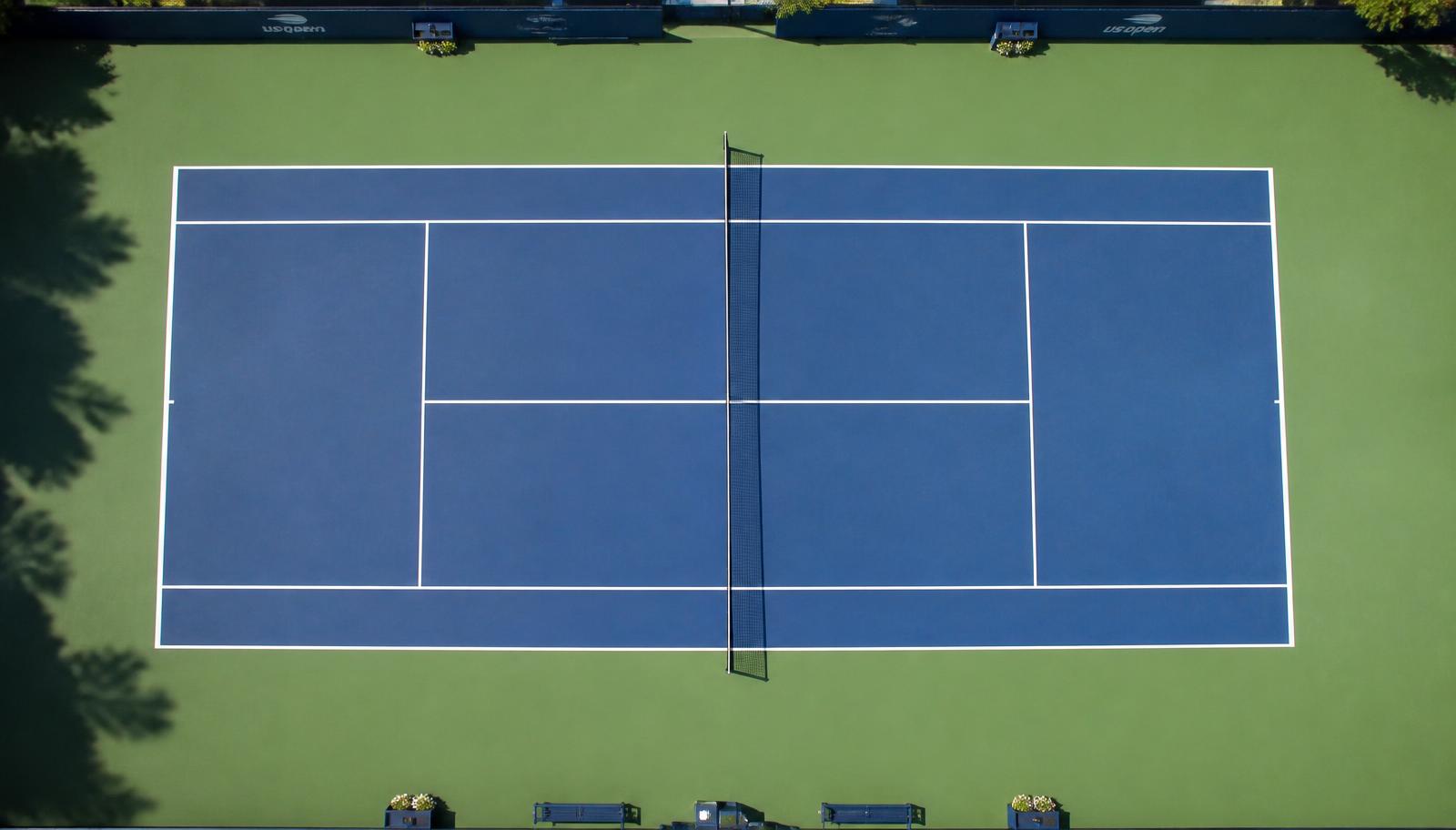
Every regulation tennis court is the same — 78 feet long, 27 feet wide for singles, 36 for doubles. What changes everything is the surface beneath the lines.
Two columns, one rally

Time is part of the rulebook
Tennis has its own clock. Between points, between games, between sets — every pause is measured to the second by the chair umpire.
When behaviour breaks the play

Tennis polices itself with a four-step ladder. The umpire issues escalating penalties, and at the top of the ladder is the rarest, most absolute punishment in the sport: default.
First offense. The umpire makes a note. Play continues.
Second offense. The opponent is awarded a point.
Third offense. The opponent is awarded a full game.
The match ends. The player is removed.
Djokovic, US Open 2020. McEnroe, Australian Open 1990.

Same court, four players, different geometry
Doubles uses the wider court — those two narrow strips along the sides, the alleys, are now in play. Four players, two per side. One serves, one receives, the other two stand at the net.
The geometry of doubles is closer to chess than to singles. Position matters more than power. Communication, more than nerve.
The rules do not favour the stronger player.
They simply define the space —
and leave everything else to the human beings standing inside it.